2020.12.01
Slowly analog or ultra-advanced digital
The other day, I read in the news about the dismissal of dancers at Tokyo Disneyland (and the Sea) due to the effects of the corona disaster, that “the person in charge of Oriental Land, the management company, gave the dancers a one-sided notice, but did not respond to their inquiries, not even to the dancers. The word “nibenai” is a term I’ve never heard used in my generation. The word “nibemo no nai” is a word that I have never heard used in my generation, but when I looked it up, I found that it means “no affection and there is no island to cling to”, apparently.
I found out that the word “nibenai” is written in Chinese characters as “glueless”. So, if you ask me what this “Jiao” is, it’s pronounced “nikawa”. In the old days, “nikawa” was an old adhesive, which was made by loosening the inner tissues and tendons of the animal skin to make it gelatinous and useful in various ways. It was made by boiling the skin, hence the name “nikawa. In other words, there’s no glue – there’s no glue – there’s no room for it to stick – there’s no way to get it together.
This glue is not something that people are too familiar with nowadays, but it seems that there are some people who need it a lot. It’s the people who write Japanese paintings. I checked the Internet and found that some Japanese painters teach the use of glue in their writings.
Japanese painting is said to be very time consuming to write because of the fixed method of writing (many processes). Three thousand pieces of gelatinized glue, cut into long and thin strips, are used as the glue between washi and paint. These 3,000 pieces of gelatinous glue are melted and used as an adhesive between Japanese paper and paints.
The company that had produced the glue for Japanese paintings until around 2010 went out of business, and Japanese painters bought up all 3,000 bottles of the glue. After that, the painter decided to make 3,000 bottles, and after a trial and error process, he found a way to make it from deerskin.
ー
The other day, when my family gathered for dinner after a long absence, I was asked to take some pictures. I always bring a film camera for such occasions because using a digital camera for private photos is boring, but when I measured the brightness with an exposure meter to see if I could take photos indoors, I found that the f/4 was about 1/10th of a ss. I brought a medium format low-light cord with me, so this f/3.5 was the maximum I could take. In the meantime, my family members were taking beautiful photos with their iPhones. I’ve come to the conclusion that the iPhone is great, and digital is convenient.
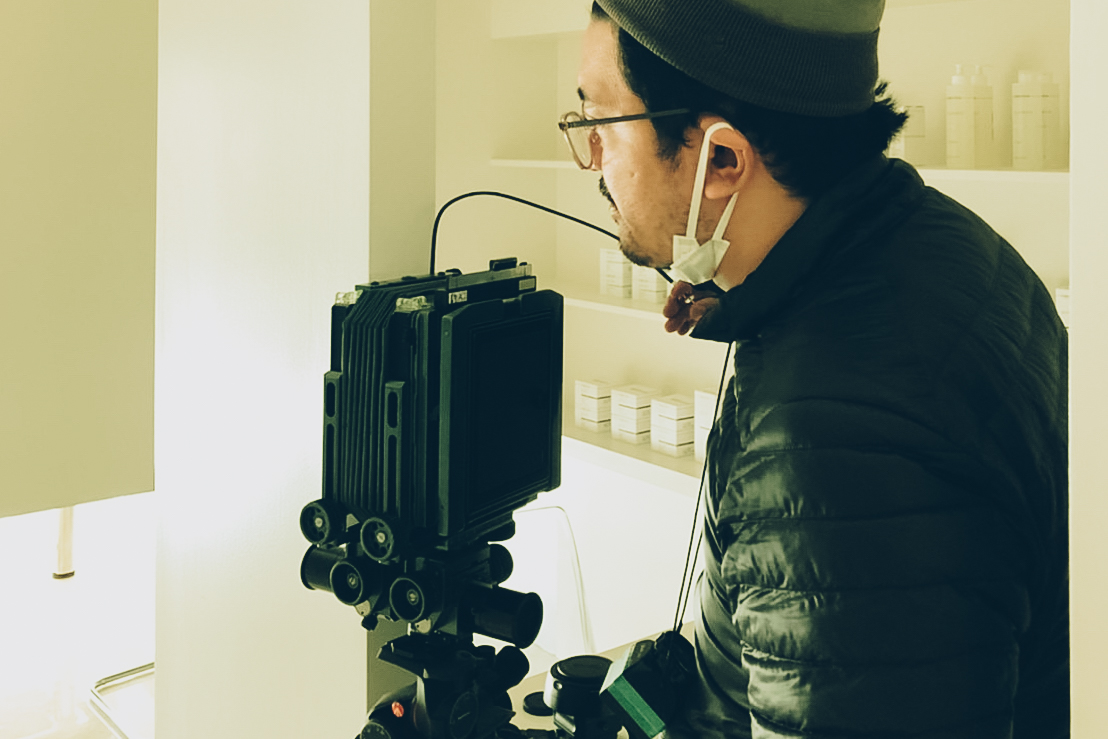
One of the reasons why I still use film is because of the good color tones it produces and because I don’t want to forget that color. Even when I’m shooting for work, I take two large-format shots of the best one cut. Then I develop them, burn them in solid color, and compare them with the photos I developed digitally, which is quite interesting. Digital colors are very similar, and if the artist does not intentionally create them, they end up being the colors of the camera manufacturer, which makes it difficult to differentiate them. The same can be said for lenses, as camera manufacturers make lenses with similar specifications. If you broaden the lens selection to include medium-format film cameras, there are many lenses made with a different philosophy than today, and each one has its own character. If you move on to large format cameras, you can use default aperture lenses and the choices of lenses are endless. Furthermore, the biggest difference in large format is the way the subject rises to the surface when the aperture is opened. It’s so natural, and sometimes it’s so amazing that it gives me goosebumps. This is different from today’s camera lenses, and it’s very interesting.
But nowadays, there aren’t many companies that make film, and Fuji and Kodak are the only big players. Ilford and other manufacturers are also making film, but the price is higher than in the past (20 years ago) because there is no demand for it. If there are no more companies making film, what will happen to the photographers who use film?
ー
Returning to the topic of glue, when I read the writings of Hi-chan, the author of this page, it bears repeating: “Japanese-style painting has many steps before writing. Just like the manners, you have to prepare each one of them carefully before you can complete it. Every time you write a picture, you have to make the paints first, but this slow writing is what Japanese painting is all about.
When it comes to earning money as a business, I feel that “easy, fast, and hassle-free” becomes important. Then, of course, it will be better to use digital technology and automate processes, and it will be a matter of how fast, how much, and how easy it is to create. What happens at this time is that everyone is using the same method of making things and placing a renewed emphasis on efficiency, so you can make a lot of things that are similar to each other. It’s very scary that in the next era, these things might really become trash.
When you get down to the super cutting-edge individuality, you’re talking about the sophistication of computer processing, or if you’re talking about a camera, you’re talking about the most advanced, highest number of pixels, and largest recording element. The destination will be the latest digital equipment and software, and the next highest peak will be the next generation of that. The most advanced is their personality. You can’t do that without spending a lot of money. But in its own way, I think it’s interesting to see the individuality of the next leading edge. But since it’s made by manufacturers as a mass-produced product, sooner or later many people will start doing the same thing, and sooner or later it will be surpassed. The most advanced individuality is really only a moment away.
If you think of analog photography, you might think of it as film, but taking a large-format photo is a complicated process. But I think a lot during the process, so I have time to find the right light, the right angle, and so on. It’s an important time. I think this is a good thing. You might be able to take a digital picture while thinking slowly, but if you’re not doing anything, you might be tempted to shoot quickly. It would be interesting if I could take my time and think about it, just like writing a Japanese painting, and I think it would allow me to express my individuality, which is not tied to the flow of the times.